
Top Espresso Machines – Top 10 Picks for 2026
1
Best Overall Pick

Breville Barista Express BES870XL
The Barista Express pairs an espresso machine with an integrated conical burr grinder, so you can grind, dose and brew from one stainless-steel unit. It has a 15-bar Italian pump that delivers 9-bar extraction after a low-pressure pre-infusion, with a thermocoil heating system and PID temperature control.
It uses a 54 mm portafilter and has a manual steam wand for texturing milk by hand, plus a separate hot-water outlet for Americanos. The removable water tank holds 67 ounces and comes with a replaceable water filter.
Because grind size and dose are adjusted by the user, there is a learning curve, which suits buyers who want to build their technique.
9.9

2
Ideal for Lattes

Breville Bambino Plus BES500BSS
The Bambino Plus is one of the narrowest machines on this list at about 7.7 inches wide, which helps on smaller counters. Breville says its ThermoJet heating system reaches extraction temperature in about 3 seconds, and PID control manages water temperature.
The automatic steam wand textures milk without hands-on steaming and lets you adjust milk temperature and texture. It uses a 54 mm portafilter and a 64-ounce removable water tank.
There is no built-in grinder, so you need to buy a separate espresso grinder; the box includes pressurized baskets for pre-ground coffee.
9.7

3
Most Versatile

Ninja Luxe Café Premier ES601
The Luxe Café Premier ES601 is a 3-in-1 machine that makes espresso, drip-style coffee and cold brew. It includes an integrated conical burr grinder with 25 grind settings and a built-in scale for weight-based dosing.
Barista Assist Technology gives grind-size recommendations and setting guidance, and a hands-free frother is included for milk drinks. It needs more space than the compact machines on this list.
9.6

4
Enthusiast Pick
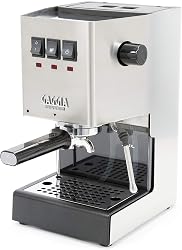
Gaggia Classic Evo Pro E24
The Gaggia Classic Pro is built around a one-piece steel frame, a three-way solenoid valve and a 58 mm commercial-style portafilter. The updated E24 version adds a brass boiler and an updated pressure valve that allows 9-bar extractions.
It is a single-boiler machine with a manual steam wand and rocker switches, so you control grinding, dosing, tamping and milk texturing yourself. It does not include a grinder, so plan to buy a separate espresso grinder.
9.4

5
Automatic

De’Longhi Magnifica Evo
The Magnifica Evo with LatteCrema System is a fully automatic bean-to-cup machine that grinds and brews after you pick a drink. It includes a built-in conical burr grinder with 13 settings, an 8.8 oz bean hopper and a 60 oz (1.8 L) water tank.
One-touch recipes include espresso, cappuccino and latte macchiato. The LatteCrema System froths milk from a carafe and has an automatic cleaning function. Pump pressure is around 15 bar, and it has a thermoblock heating system. Its removable parts as dishwasher safe.
9.1

6
Touchscreen Pick

Breville Barista Touch
The Barista Touch adds a touchscreen to Breville’s all-in-one design with an integrated conical burr grinder. It has five preset café drinks and eight customizable drinks you can save, with programmable milk temperature and texture.
It uses a 15-bar pump, a thermocoil heating system, a 54 mm portafilter and a 67-ounce tank. It reaches brewing temperature in about 3 seconds from standby and in under a minute from power-on.
8.9

7
Espresso & Cold Coffee
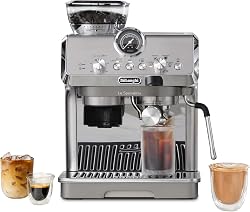
De’Longhi La Specialista Arte Evo
The Arte Evo is a semi-automatic machine with an integrated grinder, a manual steam wand and a Cold Extraction mode that De’Longhi says can make cold brew in under five minutes.
The grinder has 8 settings, and the machine offers 3 infusion temperature profiles plus Active Temperature Control. It has thermoblock heating system, a 15-bar pump and a 51 mm portafilter. A Dosing and Tamping Guide and a barista accessory kit are included to reduce mess when preparing the portafilter.
8.6

8
Compact Choice

Breville Bambino BES450BSS
The Bambino is a compact machine measuring about 7.7 inches wide, 12.6 deep and 12.2 tall. Breville says its ThermoJet system reaches extraction temperature in about 3 seconds, with PID temperature control.
It has a 54 mm portafilter, programmable 1- and 2-cup shot buttons, a manual steam wand and a hot-water button. There is no built-in grinder, so you need to buy one. The tank holds 47 fl oz (1.4 L), and wattage is 1,560 W at 120 V.
8.5

9
Entry Level Choice

De’Longhi Stilosa EC260BK
The Stilosa is the most basic machine on this list, built around a 15-bar pump and a stainless-steel boiler, with a manual steam wand for milk. The removable tank holds 1 L (33.8 fl oz), and the machine is rated at 1,100 W.
The box includes a portafilter, a scoop with tamper and single and double filters, and the filters are pressurized. It has ESE pod compatibility. A two-level cup holder fits taller cups, up to about 11 cm.
8.1

10
Budget Alternative

CASABREWS 3700 Essential
The 3700 Essential is a semi-automatic machine with a stated 20-bar pump, a 1,350 W thermoblock and a 43.9 oz removable tank.
It has a 51 mm portafilter, single- and double-shot filters, a tamper with spoon and a steam wand for milk. It has no grinder, so you need to supply one.
7.8

How We Chose These Espresso Machines.
We started by reviewing product specifications from official manufacturer listings, focusing on brewing systems, grinder quality, temperature control, milk frothing, and ease of maintenance. We also considered brand reputation, customer feedback, and independent product reviews to understand each machine’s strengths and potential drawbacks. Particular attention was given to factors that affect everyday espresso quality, including extraction consistency, durability, cleaning requirements, and overall usability.
Each espresso machine was evaluated based on its features, brewing capabilities, reliability, value for money, and suitability for different users. We considered both advantages and limitations, giving preference to machines that offer a strong balance of performance, convenience, and long-term value. Our rankings reflect this research-based assessment rather than Amazon star ratings alone. No single feature determined a product’s position; we prioritized machines that best meet specific needs, from beginner-friendly brewing to advanced espresso preparation.
Top 10 Espresso Machines Features Comparison
|
Product |
Breville Barista Express | Breville Bambino Plus | Ninja Luxe Café Premier | Gaggia Classic Pro E24 | De’Longhi Magnifica Evo | Breville Barista Touch | De’Longhi La Specialista Arte Evo | Breville Bambino | De’Longhi Stilosa | CASABREWS 3700 Essential |
|---|---|---|---|---|---|---|---|---|---|---|
|
Image |
|
|
|
|
|
|
|
|
|
|
|
Price |
||||||||||
|
Machine Type |
Semi-automatic |
Semi-automatic |
Multi-function |
Semi-automatic |
Fully Automatic |
Semi-automatic |
Semi-automatic |
Semi-automatic |
Manual |
Semi automatic |
|
Grinder |
Built-in |
Separate |
Built-in |
Separate |
Built-in |
Built-in |
Built-in |
Separate |
Separate |
Separate |
|
Milk System |
Manual wand |
Automatic Wand |
Hands-free frother |
Manual wand |
LatteCrema |
Automatic |
Manual wand |
Manual wand |
Manual wand |
Manual wand |
|
Operation |
Manual controls |
Shot buttons |
Guided settings |
Manual switches |
One-touch |
Touchscreen |
Manual settings |
Shot buttons |
Dial controls |
Basic controls |
|
Good For |
All-in-one |
Milk drinks, small counters |
Drink variety |
Enthusiasts |
Convenience |
Guided drinks |
Espresso and cold coffee |
Small kitchens |
Beginners |
Budget |
|
Water Tank |
67 oz (2 L) |
64 fl oz (1.9 L) |
≈70 oz (2 L) |
72 fl oz |
60 oz (1.8 L) |
67 oz (2 L) |
57 oz (1.7 L) |
47 oz (1.4 L) |
33.8 oz (1 L) |
43.9 oz (1.24 L) |
|
Power |
1,600 W |
1,560 W |
1,650 W |
1,425 W |
1,250 W |
1,680 W |
1,300 W |
1,560 W |
1,100 W |
1,350 W |
|
Pump pressure |
15 bar pump; 9 bar extraction |
15 bar pump; 9 bar extraction |
19 bar |
9 bar extraction |
15 bar |
15 bar |
15 bar |
15 bar pump; 9 bar extraction |
15 bar |
20 bar |
|
Heating system |
Thermocoil + PID |
ThermoJet + PID |
Thermoblock |
Single brass boiler |
Thermoblock |
Thermocoil |
Thermoblock |
ThermoJet + PID |
Stainless-steel boiler |
Thermoblock |
|
Portafilter |
54 mm |
54 mm |
N/A |
58 mm |
N/A (bean-to-cup) |
54 mm |
51 mm |
54 mm |
N/A |
51 mm |
|
Warranty |
1 year |
2 years |
1 year |
2 years |
2 years (+1 with registration) |
2 years |
2 years (+1 with registration) |
1 year |
1 year |
1 year |
|
Dimensions (inches) |
15.9 × 13.1 × 12.4 |
11.9 × 7.4 × 14.3 |
15.75 × 15.24 × 20.51 |
7.87 × 10.63 × 13.98 |
9.45 × 17.32 × 14.17 |
15.7 × 12.6 × 12.4 |
11.22 × 14.37 × 15.87 |
11.9 × 6.1 × 13.5 |
13.5 × 8.07 × 11.22 |
12.99 × 6.49 × 12.13 |
Espresso Machine Buying Guide: What Matters Most
Choosing an espresso machine can feel complicated because familiar-looking models work very differently. Some leave you in control of grinding, tamping, extraction and steaming, while others handle almost every step. The right option depends on your routine, not a long list of flashy settings.
Before buying, decide how involved you want to be, whether you need a grinder, and how often you make milk-based drinks.
1. Semi-Automatic vs. Fully Automatic
Your first choice is how much control you want. The brewing process changes considerably between a portafilter machine and a bean-to-cup system.
Semi-Automatic Espresso Machines
These models generally use a removable portafilter. You prepare the coffee and control more of the brewing process, so grinding and technique matter.
Fully Automatic Espresso Machines (Bean-to-Cup)
These machines grind, dose and brew automatically, often with preset drink choices and a separate automatic milk system. There are fewer steps to manage.
2. Grinder & Setup Breakdown
A good espresso grinder matters because tiny grind adjustments can change the flavor and flow of a shot. Plan for one if the machine does not include it.
| Grinder Setup | Good For | What You Should Know |
| Separate Grinder | People who like control | Easy to upgrade later, but it needs additional space and budget. |
| Integrated Grinder | Convenience and simplicity | One combined appliance can reduce countertop clutter and setup decisions. |
| Bean-to-Cup Grinder | One-touch coffee drinkers | Grinds and brews internally, though cleaning and maintenance still matter. |
Pro Tip on Grinders: If you plan to buy a portafilter espresso machine, spend enough on an espresso-capable grinder. Fine, consistent adjustments usually matter more than extra drink presets or decorative accessories.
3. Key Features That Actually Matter
Do not let a long list of coffee recipes distract you from the basics. Focus on these practical features:
4. How to Choose Yours: Step-by-Step
Use these four checks to narrow your shortlist before ordering:
i. Measure the space available
Check access above
Measure the machine and leave room above it for refilling the water tank and bean hopper. Also consider where the steam wand moves and whether the power cable reaches an appropriate outlet.
ii. Count your daily drinks
Match the workflow to your household
If you make one espresso each morning, a compact semi-automatic can be enough. If several people make milk drinks every day, an automatic milk system might save meaningful time.
iii. Decide how much cleaning you will do
Milk systems vs. portafilters
A manual wand needs wiping and purging after use, while an automated system adds tubes or a carafe to wash. Neither approach is maintenance-free; compare your willingness to clean each part.
iv. Choose your level of control
Traditional vs. guided brewing
Choose manual controls if adjusting beans, grind and texture sounds enjoyable. If you mostly want a reliable everyday cup, prioritize simple controls and repeatable preparation instead.
Espresso Machine Cleaning & Descaling Basics
Regular cleaning keeps an espresso machine working as designed, and the right routine depends on your model. Follow the instruction manual for your exact machine; the steps below are general. Breville’s manuals, for example, tell users to unplug the appliance and let it cool before cleaning, and not to immerse the machine, cord or plug in water.
After every use
- Remove used grounds and rinse the portafilter and basket.
- Wipe a manual steam wand right after steaming and purge it briefly. The Bambino includes a tool for cleaning the steam wand tip.
- Empty the drip tray and rinse removable parts.
- Refill the tank with fresh water.
Weekly, or as your manual says
- Wash the tank, drip tray and portafilter parts. Several removable parts on the Ninja Luxe Café Premier and the Magnifica Evo are described as dishwasher safe; check your manual first.
- Run the cleaning cycle if your machine has one. The Bambino Plus and the Ninja ES601 come with cleaning discs and tablets.
- Clean milk-contact parts. Automatic wands, frothers and carafes need their milk parts rinsed after use. The Magnifica Evo’s LatteCrema System has an automatic cleaning function, but the manual still calls for regular cleaning of the carafe.
Descaling
Mineral scale can build up inside heating parts, and how fast depends on your water hardness. The Ninja Luxe Café Premier ships with a hard water testing kit, the Magnifica Evo with a total hardness test, and the Barista Touch with a water hardness test strip. Use the result to set a descaling schedule and any water hardness setting your machine offers. Use the descaler your manufacturer specifies, rinse as the manual directs, and replace water filters on the schedule in the manual.
| Machine type | Examples | What needs attention |
|---|---|---|
| Manual steam wand | Barista Express, Bambino, Gaggia, Arte Evo, Stilosa, CASABREWS | Wipe and purge the wand after each use |
| Automatic steam wand | Bambino Plus, Barista Touch | Follow the auto-purge and cleaning steps in the manual |
| Carafe milk system | Magnifica Evo | Clean carafe parts; run the automatic cleaning function |
| Multi-function | Ninja Luxe Café Premier | Clean the frother, drip tray and removable parts per the manual |
Espresso Machines FAQs
Do I need a separate grinder?
It depends on the model. The Barista Express, Barista Touch, Ninja Luxe Café Premier, Magnifica Evo and Arte Evo have built-in grinders. The Bambino, Bambino Plus, Gaggia Classic Pro, Stilosa and CASABREWS 3700 Essential do not, so budget for an espresso-capable grinder.
Does higher bar pressure mean better espresso?
Not necessarily. Many listings state a pump rating of 15 or 20 bar, but Breville and Gaggia describe 9-bar extraction pressure. Treat the pump number as a rating, not a quality score.
What is the difference between a thermoblock, thermocoil and boiler?
In general, a boiler heats a reservoir of water, while thermoblock and thermocoil designs heat water as it flows through a heated metal block or coil. ThermoJet is Breville’s name for its fast-heating system. Our table lists the heating system each manufacturer or retailer states.
Are pressurized baskets a problem?
They are designed to be forgiving, especially with pre-ground coffee. The Bambino Plus and Stilosa listings mention pressurized filters. The trade-off is less control over extraction than with standard baskets.
How often should I descale?
Follow your manual. The schedule depends on your water hardness, which is why several models include a test kit or strip.
Can any of these make cold coffee?
The Arte Evo has a Cold Extraction mode, and the Ninja Luxe Café Premier lists a cold brew function. The other machines on this list do not advertise one.